
Worship on the Fifth Sunday after the Epiphany
10:00 am February 08, 2026
Minister: The Rev. Brad Childs Welcoming Elder: Renita MacCallum
Music Director: Binu Kapadia Vocalist: Linda Farrah-Basford
Children’s time presenter: Brad Reader: Martin Sawdon
We gather to worship God.
Music prelude
Greeting
L: The grace of our Lord Jesus Christ be with you
P: and also with you
Lighting of the Christ candle
Welcome and announcements
Preparation for worship
Call to worship:
L: Just as sunrise breaks through the darkness each day,
P: So God’s grace, mercy and justice shine forth.
L: We gather, with devotion and doubt, with weariness and wonder;
P: trusting that God’s peace and love are present here.
L: Come and worship as you are, knowing you are loved.
P: We come, rejoicing, to praise God’s holy name.
Opening praise: Holy is the Lord
Prayers of approach and confession
Holy One, We confess we have treated your world as if it were ours to use up. We’ve bought without thought, driven without care, and wasted what others need. We have favoured convenience and profit over the flourishing of your creation and the well-being of our neighbours. Forgive our greed and our short-sightedness; teach us to live with restraint, gratitude, and generosity.
We confess we have made our lives small — building walls of indifference around our comfort, avoiding hard truths, and turning away from people who hurt. We have chosen silence when compassion required action, and excuses when courage was called for. Forgive our fear and apathy; fill us with your courage to speak up, to serve, and to stand with the vulnerable.
We confess our broken relationships — words we’ve said that wound, promises we’ve broken, love we’ve withheld. Too often, we compete rather than care, judge rather than listen, and hold grudges rather than seek reconciliation. Heal our hearts; help us to forgive as we have been forgiven and to seek restoration where there is hurt.
We confess how we’ve misplaced our trust — chasing status, power, or comfort instead of relying on you. We grow anxious and restless when things don’t go our way, forgetting that you are the source of life and purpose. Remind us to rest in your presence, to surrender our control, and to trust your steadying love.
We confess the small betrayals of everyday life: the moments we choose convenience over compassion, gossip over grace, self-protection over vulnerability. These add up. In your mercy, forgive us and renew us. Teach us habits of humility, justice, and care so our lives reflect your heart for the world.
Renew us by your Spirit. Shape us into a people who steward creation wisely, love our neighbours faithfully, and live courageously for the common good. Help us to follow Jesus more closely — in thought, word, and deed — that our lives might witness to your reconciling love. Amen.
Response: I will trust in the Lord
Assurance of God’s pardon
Hear the good news of the Gospel: In Jesus Christ we are forgiven. Let us be equally forgiving. Thanks be to God.
We listen for the voice of God
Song: Open our eyes, Lord (445)
Children’s time
There is this goofy old story I’ve heard in a couple of versions, but I like this one.
Two women were fishing in the same basic spot. One woman was a very experienced fisherperson, and the other woman was a little less so. Every time the experienced woman caught a big fish, she put it in her ice chest to keep it fresh. When she got a little fish, she threw it back in the water.
But when the less experienced woman caught a little fish she put it in a basket to take home and when she caught a big fish, she would put the big fish back in the water and let it go.
Finally, the women with all the big fish couldn’t help it. So she asked, Why do you keep putting all the best ones back?
But the other woman just shook her head in confusion. She said, “I only have a small frying pan.”
Sometimes, like the woman fishing, we throw back the big plans, big dreams we make from when we were little, like you. Sometimes we get older and give up on the big ideas, big possibilities and opportunities God gives us. A lot of the time, as we get older, our faith actually shrinks a bit. Just think how many great big fish the one woman would have taken home if she just invested in a bigger pan. Sometimes we do that with God. We push away opportunities because they seem too big or bold.
Today, I want to tell you to hold on to your big dreams, and they may just come true. Jesus said that we all need that kind of childlike faith.
Prayer
Leader: “Repeat after me.”
Leader: “Dear God,”
Kids: “Dear God,”
Leader: “Thank you for big dreams,”
Kids: “Thank you for big dreams.”
Leader: “Help us to keep believing,”
Kids: “Help us to keep believing.”
Leader: “Give us brave, childlike faith,”
Kids: “Give us brave, childlike faith.”
Leader: “Help us say yes to big chances,”
Kids: “Help us say yes to big chances.”
Leader: “Teach us to trust You every day,”
Kids: “Teach us to trust You every day.”
Leader :And now we pray the Prayer given to us by Jesus.
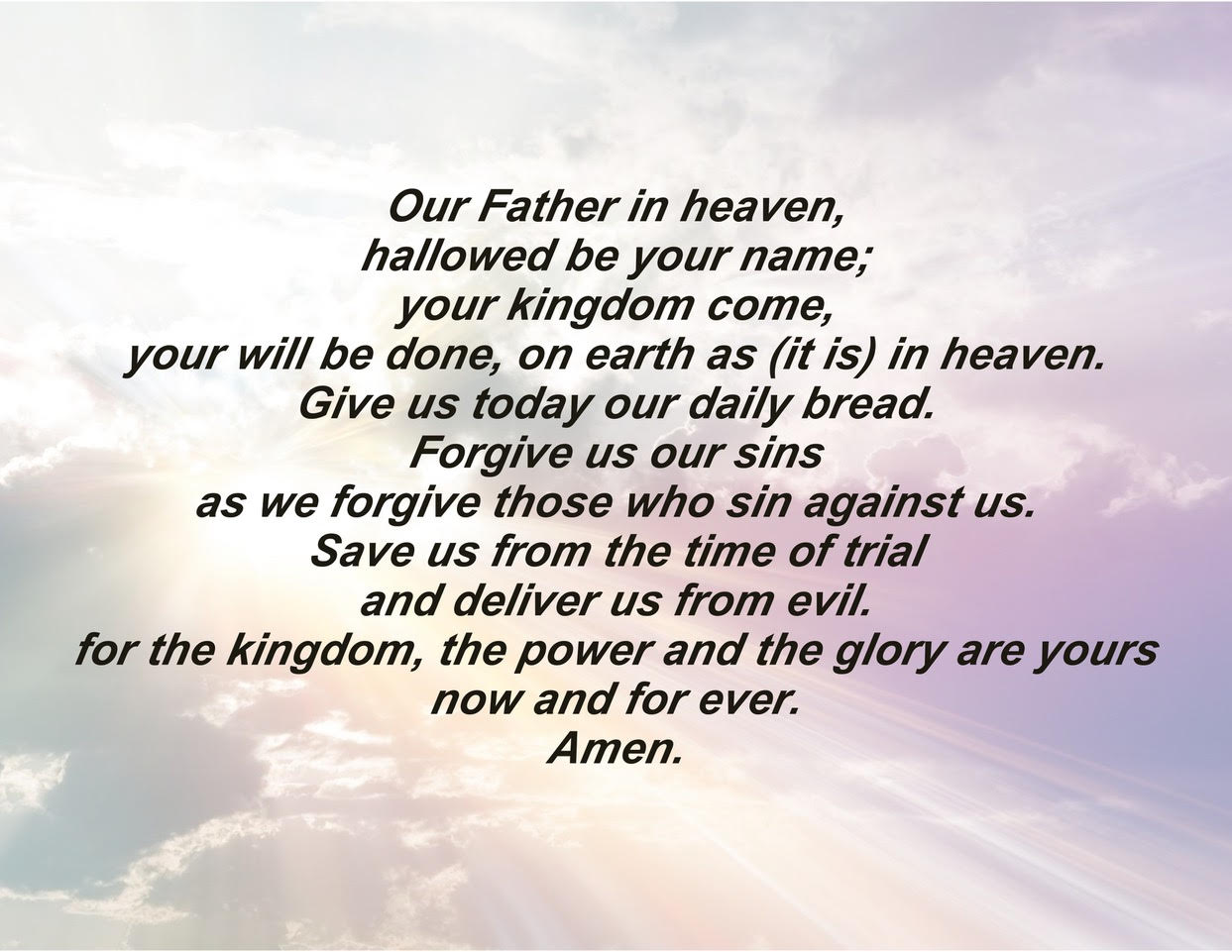
The Lord’s Prayer (535)
Song: Jesus bids us shine (773)
Scripture readings: Matthew 5:13-20
Minister’s Message: Light under a bowl?
What is your ministry? Are you blessed? How and why are we to be like salt and light in the world and what is all that salt talk about anyway? In way, that’s up to you. And it’s not always easy.
In his book Led by the Carpenter, D. James Kennedy writes: “A man walked into a little mom-and-pop grocery store and asked, ‘Do you sell salt?’ ‘Ha!’ said Pop, the proprietor. ‘Do we sell salt! Just look!’ And Pop showed the customer one entire wall stocked with nothing but salt. Morton salt, iodized salt, kosher salt, sea salt, rock salt, garlic salt, seasoning salt, Epsom salts, Tomato and oregano infused salt… every kind imaginable. ‘Wow!’ said the customer. ‘You think that’s something?’ said Pop with a wave of his hand. ‘That’s nothing! Come look.’ Pop led the customer to a back room filled with shelves, bins, cartons, barrels, and boxes of salt. ‘Do we sell salt!’ he said. ‘Unbelievable!’ said the customer. ‘You think that’s something?’ said Pop. ‘Come! I’ll show you salt!’ Pop led the customer down some steps into a huge basement, five times as large as the previous room, filled floor to ceiling with every imaginable form, size, and shape of salt, even huge ten-pound salt licks for the cow pasture.
‘Incredible!’ said the customer. ‘You really do sell salt!’ ‘No!’ said Pop. ‘That’s just the problem! We never sell salt! But that salt salesman who comes here every month! Hoo-boy! Does he sell salt!’” (1001 ill, 77)
About 2000 years ago, a very special guy named Jesus, with a very un-special name “Jesus” (the single most common name for Hebrew-born boys at the time), was walking around Palestine. Matthaion Mattaius (if you were Greek) or Mattus Yahu (if you were Jewish)… (we would say Matthew) was one of his closest friends. The book that bears Matthew`s name actually claims no author, but he has been accepted as its author since the very beginning. In the last 100 years, it has become popular to doubt Matthew’s authorship, and the vast majority of scholars agree that Matthew didn’t write it; instead, it was written in the late 90’s (long after Matthew would have died). However, just a few years ago, the works of a very early church father, Papias, were found that listed Matthew as the author, and they are indisputably dated to 63AD. So… what do scholars know?
Anyway Mathew gives us a genealogy that shows Jesus to be a pretty regular guy, next he gives this outrageous story about his birth and magi coming to visit, and then gives a short story about John the baptizer, says Jesus was tempted like any other person, provides another paragraph with about Jesus calling his own disciples (a word for student-learners) and then the next thing Matthew remembers – Jesus is up on the mount giving a group of small sermons (we call them the Sermon on the Mount).
It begins with the words of the beatitudes (which is Latin for “happy), in which this peasant-teacher is telling the crowd that’s gathered that, people that feel sad, are blessed, that people that have lost someone they love can find comfort, that people who have no power will inherit a Kingdom, that people who seek peace are called “sons of God”, and that even when people are tortured for their faith that they are blessed because they should remember that the heroes of their faith (the prophets) who the people adored, were also persecuted for their faith. He tells them things that they had never heard before. In their minds, rich people were blessed; that’s why they were rich. They weren’t rich, and so they were blessed. They thought God blessed them; they were rich! But this crazy Jesus guy told them… “Blessed are the poor”!
It was absolutely wild, unheard of, shocking, life-altering things he was saying.
Today, it all just sounds so simple, and actually, when we read these words, they kind of fly past us because we’ve heard it all before. But really think about how wild this is… “Blessed are you, whom people insult, and hurl insults at”. Blessed are the people that the world makes fun of!?!
But that’s what he said. And then after he’s told all of these common, every day people that they are blessed, even if they are poor or in mourning or sick or judged or seeking justice or whatever… after he’s told them that in reality, if they’d stop to think about their lives… they’d see how blessed they truly are… then he tells them how important they are.
He says, 13 “You are the salt of the earth.”
You see, in Jesus’ day, salt was a precious and valuable commodity. In a culture lacking refrigeration, it was the key preservative which allowed a thriving fishing industry to flourish. In an age before modern drugs, it was a critical disinfectant that saved untold numbers of lives. In a region largely devoid of high-class dining establishments, it provided a seasoning that transformed the food from distasteful to palatable. Indeed, salt was so valuable that it was sometimes traded ounce-for-ounce with gold. At times, Roman soldiers were even paid in salt. In fact, the word salary is derived from the word for salt. According to some people, if a Roman soldier didn’t do his job, he wouldn’t get all of his salt. That’s where we get the phrase “He is not worth his salt” when someone doesn’t do a good day’s work. Now, in the Palestine of yesteryear, much of the salt came from the Dead Sea or the Yam Ha Melah, which, in Hebrew, literally means “The Sea of Salt.” It was like a pool of gold.
And this wild Jesus character says, “You are the salt of the earth.”
It’s wild. He doesn’t know that. Does he? He doesn’t know all these people! Maybe some of them were terrible. Chances are, some of them are lazy. Chances are that a few Roman soldiers were actually there that day. Perhaps they didn’t work hard at all. Maybe they were or were not said to be “worth their salt”. Maybe there were people there that day who didn’t even work at all. Maybe people who couldn’t. You know… the ones everybody thought were cursed.
And yet Jesus looks out to a crowd of people and says, You know that thing that preserves our food and keeps us from dying. That thing that takes a dull life and bland food and makes it exciting… that’s you! You are like that for this world.
You are the salt of the earth.
But then he puts a small challenge to the people. He says, “But if the salt loses its saltiness, how can it be made salty again? It is no longer good for anything-”
For those of you not terribly familiar with Palestinian geography, the Sea of Salt is more than a mile and a half below sea level. The waters of The Sea of Galilee flow into the Jordan River and from there go to their final resting place in The Sea of Salt – the lowest land elevation on earth. So once the water gets there, there’s no place to go. The hot sun evaporates the water, leaving behind a chunky white powder composed of a mixture of salts and minerals. That powder contains enough salt to season meat or to flavour soup, and that’s why people used to get their salt from The Dead Sea. But it’s also mixed with minerals, and it’s not pure sodium chloride – it was quite an unstable compound. When stored in a damp environment, or even when it is mixed with a bit of moisture in the air, it would frequently begin to dissipate. That’s the surface meaning of Jesus’ word. That’s how the salt “loses its seasoning.” Jesus goes on to say (in the literal translation from the Greek), “It is good for nothing but to be thrown out and trampled underfoot by men.”
But honestly, that Jesus fellow was on to something. I mean, if we are really, actually, truly blessed… then why not share that?
I don’t know if this is true. Still, as the story goes, at the 1993 annual meeting of the American Heart Association in Atlanta, Georgia, nearly 300,000 doctors, nurses, and researchers came together to discuss, among other things, the importance of low-fat diet plans in keeping our hearts healthy.
At the conference, one well-known and well-respected cardiac surgeon, Magdi Yacob, who was a guest speaker, sat down for dinner with his wife at a restaurant far from where everyone was meeting. There, he gobbled down fat-filled fast food. He had a bacon cheeseburger and large fries and even went back for seconds. Finally, his wife asked the man whether his partaking in high-fat meals set a bad example for the other doctors and the people he was speaking to. Reportedly, Dr. Yocab looked at his wife, smiled, shrugged his shoulders and said, “I took my name tag off.”(Hot Ill, 155)
It’s funny but… It’s also not. We have to practice what we preach. That’s hard.
This Jesus knows that his audience… people that don’t know him… people he doesn’t know… he knows that they are just like anybody else. And so he repeats his point with a second illustration.
He says, 14 “You are the light of the world.”
“A town built on a hill cannot be hidden.”
15 Neither do people light a lamp and put it under a bowl. Instead, they put it on its stand, and it gives light to everyone in the house.
Jesus was talking to them, but he didn’t know them. He meant everyone. He meant you. He really meant you. Let that sink in for just a second. Jesus literally meant You right there, and you and you and you and you, YOU are the light of this world. And you can’t keep it to yourself. You have to share it.
And I know what you’re thinking right now. Some of you are thinking I’m too old to start sharing my light. What can I do?
Well, to that I say this: Verdi penned his classic work “Ave Maria” at 85, Immanuel Kant (one of the most important philosophers in the last 500 years) did his best work at 74, and Michelangelo was 87 when he did the work displayed at St. Peter’s Basilica. (Best, 9) I swear to you, you are not too old. No one in this room is too old to let their light shine! Just like no one in this room is too young or too busy or too anything else for that matter, or even too unhealthy… I just saw someone in Hospice care 4 days ago, and she made me smile, think, laugh and cry all in about 8 minutes. You aren’t too old. YOU ARE NOT TOO ANYTHING to share your light.
That doesn’t mean it’s always easy.
Just before Christmas, I read this story and put it away in my file. It goes: A missionary, home on vacation, was shopping for a globe to take back to the mission to help teach the little kids. The clerk showed her a reasonably priced globe, then another with a light bulb inside. “This one is nicer,” said the clerk, pointing to the illuminated globe, “but of course, a lighted world costs more.” (1001 Ill, 75)
What truer words have ever been spoken? Being salt and light does, in fact, “cost more”. It’s not free. It will cost you something. But it’s worth it. Your ministry, whatever it is, is worth it.
I tried to track down the original author of this mission statement, but I failed. So I’m going to have to leave it as author unknown for now. But it’s rather beautiful and worth sharing. It goes like this:
The foundation of ministry is Character.
The nature of ministry is service.
The motive for ministry is love.
The measure of ministry is sacrifice.
The authority of the ministry is submission.
The purpose of ministry is the glory of God.
The tools of ministry are the Word of God, prayer, and you.
The privilege of ministry is growth.
The power of ministry is the Holy Spirit,
And the model for ministry is Jesus Christ. (184)
Before I end today, I want to point out one more thing. Jesus says that you are to share your salt and your light with the world. He asks why a person would light a lamp and then hide it. If we have something good to share, why hold it? And that’s a good question. Because I hide it sometimes. I think I shy away from it. And yet, Jesus never says that sharing it is what gives you your worth. In fact, Jesus never says that you gain anything by your sharing. Instead, he says that people will see the father in you. The idea is that you get no glory – God does. But he never promises us gain. He also never promises to add blessings to you.
And he would never say that!
Because to him, you are already Salt. You are already light. There are no conditions. And you are already, no matter how normal or lowly you think you are, blessed.
No matter what you do or don’t with this message. You are Salt and Light in this world. And you should never put your light under a bowl. Shine. – Amen
Song: In Christ alone
We respond to serve God.
Our time of giving

Prayers of thanksgiving and intercession
Thanksgiving for Offerings
Gracious God, we thank you for the gifts placed in our hands and before your altar. These offerings are signs of your generosity at work among us — resources, time, and trust returned for the work of your kingdom. Use them to feed the hungry, shelter the vulnerable, welcome the stranger, and proclaim your love in word and deed. Multiply what we offer and shape us by giving, that our lives might reflect your compassion and justice. Through Jesus Christ our Lord. Amen.
Prayers of the People
United in hope and guided by your Spirit, we bring our prayers before you.
– For the church worldwide: that we may be faithful stewards of your gospel, bold in witness, humble in service, and united in love. Lord, hear us. Lord, graciously hear us.
– For leaders of nations, communities, and institutions: grant wisdom, integrity, and a spirit of justice, that policies and decisions protect the vulnerable and promote the common good. Lord, hear us. Lord, graciously hear us.
– For those who suffer in body, mind, or spirit: bring healing, comfort, and courage to the sick, the grieving, the lonely, and the depressed. (We name before you those in need…) Lord, hear us. Lord, graciously hear us.
– For our neighbourhood and environment: teach us to care for creation, to reduce harm, and to share resources fairly so future generations may thrive. Lord, hear us. Lord, graciously hear us.
– For families, workplaces, and schools: strengthen relationships, mend what is broken, and inspire compassion and respect among people of all ages. Lord, hear us. Lord, graciously hear us.
– For those who are persecuted for faith or conscience: grant protection, endurance, and the reassurance of your presence. Lord, hear us. Lord, graciously hear us.
– For our congregation’s ministries and ministries we support: bless the work of feeding, teaching, comforting, and reconciling. Guide our generosity and our hands to serve. Lord, hear us. Lord, graciously hear us.
– For ourselves: give us repentance where we have failed, boldness to love our neighbours, and patience to wait on your timing. Lord, hear us. Lord, graciously hear us.
Hear us, O God, as we commend all these prayers to you, trusting in your mercy through Jesus Christ, our Saviour. Amen.
Song: Lord, the light of your love is shining (376)
Sending out with God’s blessing
The Lord bless you and keep you; the Lord make his face to shine upon you and be gracious to you; the Lord lift up his countenance upon you and give you peace. Amen.
Response: The blessing
Music postlude
————————————————————————-
Numbers in brackets after a song/hymn indicate that it is from the 1997 Book of Praise of the Presbyterian Church in Canada. Those and other songs are being used in accordance with the specifications of Dayspring’s licensing with One License (3095377) and CLC (A735555).
The Rev. Brad Childs retains the copyright (© 2026) on all original material in this service. As far as Brad Childs is aware, all of the material that has not been attributed to others is his own creation or is in the public domain. Unacknowledged use of copyrighted material is unintentional and will be corrected immediately upon notification being received.
Video recordings of the Sunday Worship messages can be found here on our YouTube Channel.