
Worship on the Third Sunday of Lent
10:00 am 08 March 2026
Online & Onsite (Mixed Presence) Gathering as a Worshipping Community
Led by Raymond Baker Music director: Binu Kapadia Vocalist: Lynn Vaughan
Elder: Lynn Vaughan Readers: Saber and Felix Fort
We gather to worship God
Music prelude
Greeting
L: The grace of our Lord Jesus Christ be with you.
P: and also with you.
Lighting of the Christ candle
Welcome and announcements
Silent preparation for worship
Call to Worship
One: God gave us the covenant of the law to guide us and help us live with our neighbours in love.
All: When we break God’s law, we leave our neighbours hurt and bruised.
One: God’s law is a gift to us, showing us how to keep our part of the covenant.
All: Even through old pain and wounds, may we embrace the new life that Christ can bring.
Opening praise: Great are You, Lord
Prayers of approach and confession
Lord, make us an instrument of your peace.
Where there is hatred, let us bring love.
Where there is offence, let us bring pardon.
Where there is discord, let us bring union.
Where there is error, let us bring the truth.
Where there is doubt, let us bring faith.
Where there is despair, let us bring hope.
Where there is darkness, let us bring your light.
Where there is sadness, let us bring joy.
O Master, let us not seek as much
to be consoled as to console,
to be understood as to understand,
to be loved as to love,
for it is in giving that one receives,
it is in self-forgetting that one finds,
it is in pardoning that one is pardoned,
It is in accepting your sacrifice, Christ, that we have eternal life. Amen.
(Modified Prayer of St. Francis of Assisi)
Response: I waited. I Waited on You, Lord.
Assurance of God’s love
Scripture teaches that there is a time for every matter under heaven.
A time to weep and a time to laugh; a time to mourn and a time to dance.
In confessing our sins to God, we have offered God our tears of regret.
Now is the time to rejoice in God’s mercy:
In Jesus Christ we are forgiven.
In Jesus Christ, we can make a new start.
Thanks be to God.
We listen for the voice of God
Children’s time
Response: Jesus loves me (373)
Story
Prayer
The Lord’s Prayer (535)

Transition music
Song: I hunger and thirst (198)
Today’s Message
Scripture reading: John 4:1-42
Response: Behold the Lamb of God
Message: Lessons from the story of the woman at the well
Introduction: The Most Important Question
When I first became a Christian, an older gentleman at Central Baptist used to approach me every once in a while. He would always ask the same simple question: ‘How is your relationship with God?’ It sounds like a basic question, doesn’t it? But in reality, it is the most vital question we will ever be asked. In our reading today, we meet a woman whose life was completely transformed by a relationship with Jesus. And as we’ll see, that transformation didn’t stop with her; it spilled over, changing some of the hearts of an entire community.
As we look at the woman’s story found in John 4, I want you to remember: God is the same today as He was in the Samaritan woman’s day. The same transformation the woman experienced is available to us today!
Before our reading today, Jesus encountered Nicodemus—a leader in Hebrew Law—Jesus explained to Nicodemus that one must be “born again” to enter the kingdom of God.
In the reading that Felix and Saber read so well today, Jesus takes that message of salvation further, using the amazing illustration of living water.
I believe Jesus’s interaction with the Samaritan woman at the well offers us five life-changing lessons.
- Breaking the Barriers
First, we see Jesus breaking barriers. I have heard so many sermons that were on this very point.
There are lots of reasons why Jesus “should not” have talked to this woman.
At this time in history in the middle east women were not on equal ground as men. So just a man talking to a woman was counter-cultural. For a Rabbi to speak to a woman in public was very counter-cultural.
The next reason was the Samaritans were an ethnoreligious group living in the region of Samaria between Judea and Galilee. They were despised by Jews due to their mixed Assyrian-Hebrew ancestry and differing religious practices. The Samaritans were descendants of the Northern Kingdom of Israel who intermarried with foreign peoples after the Assyrian conquest. Samaritans worshipped Yahweh, but used their own version of the Torah and built a temple on Mount Gerizim, rather than worshiping in Jerusalem like the Jews did. Most Jewish people of the time distrusted and disliked Samaritans thinking that they were heathens and lawless. Actually, there was a mutual distrust between these two cultures.
The fact that Jesus (a religious leader) would even associate with a Samaritan would be shocking. It reminds me of the Sesame Street song: “One of these things is not like the others.” The woman and Jesus’ interaction would not fit with many of the accepted cultural norms of that time. Jesus was showing that God’s love isn’t restricted by geography, race, or gender. Jesus was definitely showing that God loved everyone in the world.
We know that God loves everyone in the world so much that He sent his only son–that whoever believes in Jesus has eternal life. This means everyone, no matter who you are, Jesus died on the Cross for you. If you repent of your sins and accept him as savior you can enter the Kingdom of God and have eternal life.
Illustration: “I want to take you back with me to a quiet room in a palliative care ward—a place where I encountered a dying man.
I was serving as a chaplain at Norwood palliative years ago. One day on the palliative ward was a man whose life had been lived at the intersection of many margins. He was Indigenous. He was gay. He was dying of AIDS and Hepatitis and other things. He did not have any visitors. I noticed he was actively dying but still a bit cognizant and alone in the room.
I remember putting on medical gloves as I pulled them on—a thin, latex barrier that could not stop a human connection. I took his hand in mine. Listening to the rhythm of a life slowly fading. I gently told him the salvation message as he slowly died. I held on to his hand until his very last breath
I do not tell you this to make me look good. I tell you this because of the bridge that was built in that room.
Think of the distance the world put between me and that man:
- Between the sacred and the stigmatized.
- Between me a heterosexual man representing the institutional Church and a dying gay man the world had probably often rejected but God still loved dearly.
In that hand hold, those distances vanished. And that, my friends, is the heart of the Gospel. If I—a flawed, finite human like me—could reach across that divide to offer presence and peace, how much more does the Creator of the Universe reach toward us?
God does not wait for us to be ‘presentable.’ He does not wait for the symptoms of our brokenness to disappear. Just as Jesus died for every soul without exception, He stands at the bedside of our lives, reaches past our labels, and takes us by the hand. He accepts us exactly as we are, at the very moment we come to Him and find solace in Christ. Jesus accepted the Woman and He accepts us.
Galatians 3:28 declares to all believers in the salvation of Christ that, “There is neither Jew nor Greek, slave nor free, male nor female, for you are all one in Christ Jesus“
- Seeking the Outcast
Notice the timing: the Samaritan woman is at the well in the middle of the day. Most women at that time in history went to the well in the cool of the morning or late evening and then they would socialize with the other women. Coming alone in the heat of the noon sun speaks volumes about the Samaritan Woman’s shame. She was a social outcast, yet Jesus went out of His way to find her.
Do we judge people the way the community judged this woman? We often categorize people and keep them at arm’s length.
Illustration: In the 1960s, a prestigious, conservative Anglican church stood directly across from a major university in San Francisco. The church was a place of high liturgy, polished wood, and “proper” decorum.
The service was seconds from beginning when the heavy oak doors swung open. In walked a young man—a university student. He is the very definition of the counter-culture hippy movement of the 1960’s. With his long, wild hair, his beaded and tasseled shirt, and those weathered, cut-off shorts, he looked like a man who had walked straight out of Woodstock. Even more shocking to the congregants was that he was barefoot.
As the congregation watched in stunned silence, this young man didn’t take a seat in the back. He walked all the way down the center aisle, reached the very front, and sat down cross-legged right on the floor almost directly in front of the raised pulpit.
The tension in the room was suffocating.
From the back of the sanctuary, the head usher—a “Sideman” in the truest English sense—began to move. He was an elderly, dignified man, who came from London, England. He was dressed in a crisp bespoke three-piece suit, a highly starched white shirt and red tie in a full Windsor knot. His shoes were polished to a mirror shine. He walked with a cane, and every step he took sent a tap echoing through the large silent sanctuary.
The congregation held its breath. They expected a stern rebuke from their proper elder. They expected a demand for the hippy to leave. Even the minister, standing high in his pulpit with his long vestments on, waited and expected and even looked forward to the confrontation.
But when the old man reached the young hippy man, he didn’t point to the door. Instead, he dropped his cane. He reached out a trembling hand to the hippie for balance, and with great effort, he lowered his body in his expensive suit onto the hard floor.
There they sat, side-by-side: the proper gentleman of the old world and the face of the counter culture hippies of the 1960’s.
The minister looked down, a single tear came down his face. He closed his notes and addressed the congregation with only one sentence:
“What I’m about to preach to you cannot compare to the sermon we have just witnessed.”
Do we judge people like the Samaritan community judged the woman or the congregation that viewed the hippy? Christ came for all to find peace and salvation. As I noted before, Jesus’ conversation with Nicodemius, an intellectual and scholar of the Law parallels Jesus’ conversation with the adulterous Samaritan woman at the well. Jesus came for an intellectual and also an adulterous woman. Can we understand that Jesus came for everyone? I sometimes forget this and judge young men that come to church with baseball caps on or teenage girls in very short skirts in church. Jesus came for all of us. Even me who has judged.
- Uncovering Sin & Offering Grace
Jesus gently confronts the woman’s past—her five husbands and her current situation—not to condemn her, but to offer her a new life. This isn’t just about getting to heaven; it’s about bringing the Kingdom of God to earth now. When we pray in the Lord’s prayer “Thy kingdom come here on earth as it is in heaven” is about bringing the kingdom of God here and now.
I find it interesting that the personal life of the Samaritan woman actually mirrored the Samaritan community, which at the time worshiped Yahweh but also served the many Assyrian gods.
We shouldn’t be too quick to judge the woman or the Samaritans. I love my wife, Jacquie, dearly and am faithful to her—but am I always “faithful” to God? Do I look to money for security instead of God? How about you?
We all come with baggage. As George Beverly Shea used to sing at the massive Billy Graham crusades: “Just as I am – though toss’d about, with many a conflict, many a doubt… O Lamb of God, I come!”
It is my prayer that everyone no matter what they have done can come accept the grace of God through Jesus’ sacrifice on the cross.
- Quenching the Spiritual Thirst
The “living water” Jesus offers carries a profound double meaning. In the ancient world, “living water” (Hebrew: mayim hayyim) referred to water that was moving—a bubbling spring or a flowing stream—as opposed to the stagnant, still water of a cistern or in this case Jacob’s well.
When Jesus speaks of Living Water, He is tapping into a rich biblical tradition. In Jeremiah 2:13, God describes Himself as the “fountain of living waters,” the direct and inexhaustible source of grace and life.
Consider the setting: this well was a physical legacy left by the patriarch Jacob. To the woman, Jesus’ claim of “living water” sounded like a geographical impossibility. She likely wondered if Jesus knew of a hidden, subterranean river running even deeper than Jacob’s ancient well. But the truth Jesus is talking about is more profound than any geological find. The source He speaks of isn’t found in the earth; God offers us this Living Water deep in our soul.
Jesus addresses the universal reality of spiritual thirst—a deep-seated longing for grace and purpose that no physical substance can quench. This offer of eternal life wasn’t just a lifeline for a marginalized Samaritan woman; it is a universal invitation. Whether we are Christians or “outcasts,” we all carry a parched soul that only Jesus can satisfy. Jesus offers a grace that does not just sit still like the water in a well, but flows through us, bringing significance to our lives today and into eternity–if we accept Christ as our Savior. Even if you are a Christian now–the living water can deepen your relationship to God.
- The Unlikely Evangelist
To the Samaritan woman Jesus all of a sudden seems to know everything about her. She is stunned at all He knew. Next, the Samaritan woman says she is waiting for The Messiah or the Christ. Jesus tells her that He is that Messiah. The Samaritan woman is stunned and goes into town to tell about how Jesus knew all about her. The woman becomes the first evangelist to the Samaritans. . Her testimony leads a crowd from the town to encounter Jesus and confess Him as
the “Savior of the World”. As I have said she is a woman and a woman with a bad reputation but she spreads the word about Jesus to the town regardless of her gender and reputation. The Eastern Orthodox tradition even labels her as “equal to the Apostles”.
I have a Master’s degree in Divinity. Should clergy with education be the only evangelists of the good news about salvation through believing in Christ? Absolutely not! In my mind one of the reasons I preach is to send out all who hear the message into the world to spread the good news about Christ. If the Samaritan woman can be the light of Christ to her town can’t we be the light of Christ to the world. Each of us individually and the entire body of Dayspring can spread the good news to our communities, Edmonton, Alberta, Canada, and the whole world!
This reminds me of the great commission. This is the last command from Jesus to His disciples found in the gospel of Matthew, “therefore go and make disciples of all nations, baptizing them in the name of the Father and of the Son and of the Holy Spirit, and teaching them to obey everything Jesus has commanded you. And surely Jesus is with you always, to the very end of the age.” You do not need to have a Master’s degree. You just need to know Christ as saviour and to go represent Him and tell about the Gospel Message to the World and Christ will be with you as you do it
Conclusion
“As we close our time together, we look back at the woman at the well and realize her story is our story. Just like the man whose hand I held in that hospital room, the Samaritan woman stood at the intersection of isolation and needed to experience transformation!
From the woman at the well who had an encounter with the Savior, we can glean five truths that can change the way we live:
- First, Jesus breaks every barrier. Whether it is a well in Samaria or a palliative care ward, God sends Christ or his followers to everyone—no matter who they are or what they have done in their past.
- Second, Grace is a universal gift. Jesus endured the cross so that no one—not the outcast, not the forgotten—should perish, but instead find salvation and eternal life.
- Third, God sees the outcast. While the world labels and classifies, Christ models a love that looks past the person and the history to see the soul. He sees the Hippy, the adulterous woman, the dying man in the palliative ward and us. Do we love our neighbour as ourselves like God loves all?
- Fourth, Christ alone quenches our thirst. We all have a parched place in our hearts that the world cannot fill. Today, you are invited to come to the well and drink of the Living Water God provides.
- Finally, you are called to go and tell the Good News. The woman at the well didn’t wait for a theology degree to share her joy. She simply went. You don’t need a title; you just need to know the Savior.
So, I ask you today: Will you drink from the living water and allow Christ to transform your life? Will you let Him take your hand and fill your heart? And once you are filled with God’s Living Water, who will you go and tell?”
Song: As water to the thirsty (688)
We respond to serve God: Our time of giving
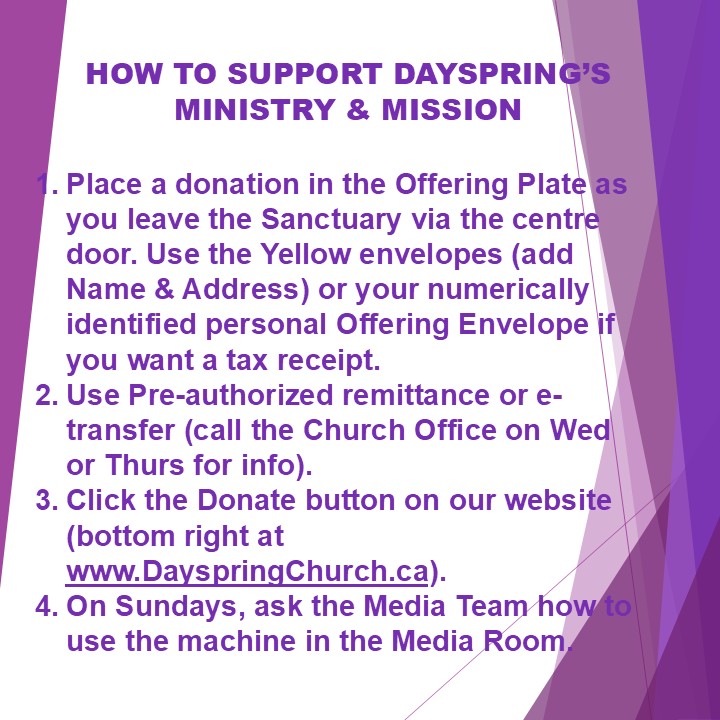
Reflection on giving: Having tasted the living water in Christ’s love and forgiveness, we bring our gifts to God in gratitude for such refreshment and renewal.
God has given us so many gifts in Christ and in creation. We offer our gifts in gratitude for the possibilities we enjoy, trusting God to multiply what we bring for goodness’ sake.
Prayer of gratitude and for others and ourselves
Lord, we come before you today to say thank you. Thank you for all you have given us–for all the blessings that we can and cannot see. With a grateful heart we thank you Lord for saving us from darkness and delivering us from evil. We accept what you did on the cross as you took our sin and shame. You can take away our sickness and can heal our pain. We thank you for all you have done and are about to do in our lives. Thank you, Lord.
Song: Come, let us sing to the Lord our song (412)
Sending out with God’s blessing
May you be filled today with the Living Water that only God provides—a spring welling up to eternal life. As you go, may you love the Lord your God with all your heart, soul, and mind, and extend that same radical love to every neighbour you encounter. And may you know Christ as the true saviour of your lives. In the name of the Father, Son, and Holy Spirit. Amen.
Response: Sing Amen
Music postlude
————————————————————————-
Numbers in brackets after a song/hymn indicate that it is from the 1997 Book of Praise of the Presbyterian Church in Canada. Those and other songs are being used in accordance with the specifications of Dayspring’s licensing with One License (3095377) and CLC (A735555).
Raymond Baker retains the copyright (© 2026) on all original material in this service. As far as he is aware, all of the material that has not been attributed to others is his own creation or is in the public domain. Unacknowledged use of copyrighted material is unintentional and will be corrected immediately upon notification being received.