
Worship on the Eighth Sunday after Pentecost
10:00 am July 19, 2026
Minister: The Rev. Brad Childs
Worship led by: Lynn Vaughan
Music Director: Binu Kapadia Vocalist: Fionna McCrostie
Welcoming Elder: Sam Malayang Reader: Nesta Sawdon
Children’s time: Courtney Vaughan
We gather to worship God
Music prelude
Greeting
L: The grace of our Lord Jesus Christ be with you
P: and also with you
Lighting of the Christ candle
Welcome and announcements
Preparation for worship
Call to worship:
L: We gather in the presence of God;
P: We have come to worship and praise God’s name.
L: We gather in joy and expectancy;
P: We have come to encounter God in beauty and wonder.
L: Speak, Lord, for your servants are listening;
P: Speak your word of life to us, O God.
Opening praise: Forever God is faithful
Prayers of adoration and confession
Creator God,
in you, we live and move and have our being:
You have been with us through good times and difficult ones.
You give us strength to face the challenges around us.
You offer us rest for our bodies and souls when life seems too demanding.
We turn to you for wisdom this day,
trusting we will find the peace and comfort we long for in your presence.
We praise you for all you offer us in your great faithfulness.
Fill us with your Spirit in this time of worship.
Open our minds and hearts, so that we may see as you see,
love as you love, and follow your ways for the sake of Christ our Lord.
In recalling all that you are and all that you have done,
we remember who we are and what we have done,
and we confess to you our sins in this moment of silence.
………………
Ever present God,
you know our innermost thoughts and see our thoughtlessness.
We confess our impulsive actions and reactions
when we spoke before we thought,
acted rashly and hurt others.
We confess our stubborn attitudes
and ask forgiveness for refusing to show mercy to others or to forgive.
In your kindness, O God,
forgive who we have been,
amend who we are,
and direct who we shall be
through the grace of Christ, our Lord. Amen
Response: Glory, glory, hallelujah
Assurance of God’s pardon
Remember that God is slow to be angry and quick to forgive; kind and gracious to all. Know that your sins are forgiven through the grace of Jesus Christ, and forgive those who have sinned against you, just as Christ teaches us.
We listen for the voice of God
Song: Jesus, we are gathered (514)
Children’s time: Good or Bad?
Today, we’re going to play a little game show called ‘Good or Bad?’ Everyone is welcome to participate, children and congregation alike, so let’s have some fun with it! I will put up on the screen a couple photos, and you will vote on which one you think is good … and which one is bad or poisonous. Let’s see how we do. Are you ready? (pictures can be seen here)
All right, here’s our first set of pictures.
These look like some beautiful flowers that can be found in our own gardens.
(point to one picture) If you think this is the dangerous one, raise your hand.
(point to other picture) If you think this is the dangerous one, raise your hand. Let’s see how you did.
Angel’s trumpet is the poisonous one; Snapdragon is safe.
All right, let’s look at the next one.
(repeat process for other pix)
Ooooh, some plump red berries this time. What do you think?
Lingonberry is safe to eat; Yew Berry is not.
These look like delicious apples, don’t they?
Manchineel Apple is also known as “the little apple of death” and is sometimes
referred to as the most dangerous tree in the world; Granny Smith apples are a
favourite for most of us to eat.
Here’s some lovely purple flower stalks. So pretty and soothing looking.
Lupines are toxic; Lavender is good.
Lasty, we have these juicy looking berries. They remind me of plants growing in my parent’s yard!?
Huckleberries are yummy; Ivy Berries are extremely toxic.
So, how did you do? Some of those were really, really tricky, weren’t they?
It’s hard sometimes to know what is safe and good and what is bad just by looking at it.
Jesus told a parable about the kingdom of God, where he talked about some weeds that had got mixed in with a whole lot of good wheat plants, and the farmer had to try and sort them out from each other.
God is like that farmer whose job it is to decide which people are good and which are not, and that parable is to remind us that God is the only one who truly knows what’s in the heart of each person. It is not our job to decide or judge other people. Our job is just to share Jesus with others, so they can learn about God’s kingdom and make their own decision to know and love him, too.
Let’s have a short prayer together before you head out to Sunday School.
This is a repeat-after-me prayer.
Dear God,
Thank You for loving us.
Help us grow like the good wheat,
showing kindness, love, and obedience every day.
When we see wrong choices,
give us patience and wisdom,
remembering that only You know
what’s in each person’s heart.
The Lord’s Prayer (535)

Song: God of mercy, God of grace (39)
Scripture: Psalm 86:11-17 and Matthew 13:24-30, 36-43
Response: Behold the lamb of God
Message: Weeds!
In today’s gospel reading, we get another agricultural-themed story. This is part two, you might say, of Jesus telling us parables about farming – to teach us about ministry, and to teach us about his kingdom. Last week, we heard the Parable of the Sower, about the farmer who scattered his seed widely, and found some of his seed landing on the good soil and bearing much fruit.
I’d mentioned last week that I have a university degree in agriculture, and that’s why these particular parables are some of my favourites. This one, though, hits even a little closer to home because I actually worked as a crop inspector for Agriculture Canada during the summers while I was in school. My job was, literally, to look for weeds among the wheat … or whatever crop I happened to be walking through … for farmers growing pedigreed seed. I find it very fitting that I get to share a gospel message with you today about that very same thing!
So, last Sunday’s parable offered a very optimistic teaching – we were told to just sow the seeds of God’s word, without worrying about where those seeds land, and trust God with the results. And when you do, some of the seeds that you plant will bear much fruit. But Jesus follows up that optimistic parable with today’s parable, which is either pessimistic, or realistic, depending on how you look at it. Either way, it points out that whenever we are trying to sow the seeds of God’s word, there is always an enemy trying to undermine our efforts.
The surprising thing about today’s parable to me is that it is not just about weeds. We all know about weeds, which grow very naturally, without any help, and cause a lot of problems in our gardens and our lawns. But Jesus is warning us here about an enemy, who intentionally plants weeds.
The Enemy
So, today, we need to think a little about this enemy. But as we do this, we will keep in mind not to fall into either of two common traps – either refusing to believe that the enemy even exists – or – spending too much time thinking and worrying about this enemy.
First of all, let’s acknowledge that we have an enemy. As we sow the seed of God’s word, as we sow seeds of faith and love and hope, and kindness and forgiveness and patience and justice, in our world, our enemy is sowing seeds of discontent and fear, of anger and hatred and frustration and despair.
We have an enemy, and his name is Satan. And Jesus reminds us in this parable that Satan is very real and is very busy trying to undo what Jesus and his followers are doing. Satan will work with whatever is available: things like pandemics and uprisings and corrupt government leaders and wars and … the list goes on. These things raise anxiety and frustration, and that’s just like fertilizer in Satan’s garden. He is just using all of that to grow his harvest of discontent and frustration and anger and despair.
But let’s also remember today that Satan’s cause is lost. The war is over. Jesus willingly went to the cross to defeat Satan once and for all, and all we have left is the clean-up operation. Satan has nowhere to go. He’s dead, he just doesn’t know it yet. He’s still running around making a mess, but it is just a matter of time before he is no more. We don’t want to deny that he exists, but we don’t need to worry about him succeeding at his quest.
False Wheat
But now there’s a part where this parable really gets interesting. Because it is not just teaching us about the gospel’s enemy, it is also showing us one of his favourite tactics. And it is a very clever tactic. You see, when the farmer sows the good seed, the enemy does not try to dig it up. He doesn’t try to burn the field. He doesn’t poison the wheat or steal the wheat. Instead, he plants weeds among the wheat. Weeds that, at first, look just like the wheat. These particular weeds were called “tares” in biblical times, or “darnel” these days, or sometimes even “false wheat.” And this false wheat looks just like the real wheat until it matures and bears seed. But by then, the roots of this weed have surrounded the roots of the wheat in order to suck up all of its nutrients. And because its roots are so intertwined with the roots of the wheat, pulling the weed out at this point would also uproot the wheat plant.
So, even though the farmer’s servants in this parable want to go and get rid of these weeds, the farmer wisely tells them no, because at this point, they can’t be distinguished from one another, and even if they could, pulling up one will pull the other up also. Instead, the farmer suggests that they let them both grow together until the harvest. And then, at harvest time, they can collect the weeds and burn them before gathering the wheat into the barn.
So, you can see how clever this farmer’s enemy is. And obviously, Jesus is trying to teach us that the gospel’s enemy is just as clever. He is very good at planting evil in the world that looks good, and that is so intertwined, that to get rid of one, we would have to do away with the other.
Just as the wisest farmer cannot always tell the difference between the weeds and the wheat, the wisest Christian cannot always tell the difference between good and evil. In that way, this is a very humbling parable, isn’t it? It teaches us that we can’t do it all. We can’t fix all the problems of our world. Even if we were in charge. Most of us, truth be told, have enough of a time fixing our own problems. And we certainly can’t fix all of our neighbour’s problems, or our loved ones’ problems, or society’s problems, as tempted as we are to try. So, this parable reminds us not to judge other people too quickly, and not to judge what is happening in our lives too quickly, either. It is hard to tell the wheat from the weed. So, we are encouraged to be patient, and to await the final harvest.
That doesn’t mean that we should ignore all the weeds in our world. But this parable does caution us, by reminding us that it is often very hard to distinguish between the two types of plants. We can’t always pull the weeds without also uprooting the wheat. And our view of the world is limited. We don’t always know God’s ways and God’s purposes. And oftentimes, it is only in hindsight that we can see God’s purpose being worked out in our life, or in our world.
That seems to me to be what Jesus is teaching us today. That it is very hard, sometimes, to tell what is good and what is bad. Who is good and who is bad. Sometimes, we have to wait until the final harvest to sort it all out. And that takes patience, and faith, and hope.
What to Do?
But you still might be wondering: what do we do about all the weeds in our world, and the evil all around us? We can’t just ignore it all, can we? We can’t just ignore the gospel’s enemy. So, what should we do?
I think that this parable, when it comes right down to it, teaches us something similar to last week’s parable. That in the midst of our very complicated world, what we should do is keep planting seeds. We should spend more time planting wheat than pulling up weeds. We should spend more time planting kindness and mercy and forgiveness and love, than trying to pull up hatred and envy and frustration and anger.
It is true, as we learned last week, that some of the seeds we plant will fall on the path, and not even take root. And it is also true, as we’ve learned today, that even the seeds that fall on good soil will still have to deal with weeds planted by the enemy. But it will all get sorted out in the end. And when it comes time for the harvest, our job is simply to make sure that there is plenty of wheat to gather.
In this world of ours, it is easy to grow discouraged, as we see the weeds – as we see the evil – seemingly growing out of control. But here in this parable, Jesus again reminds us that our work done for him is not done in vain. That the seeds we plant will bear fruit. That the weeds will not win the day. And that the wheat will prevail, in the end.
Closing
Our world has a master gardener who knows exactly what he is doing. Isn’t that good news? And our master gardener assures us that come harvest time, the wheat will be gathered and brought into his barn, and the weeds will be burned. It will all be sorted out in the end, by the only one truly able to sort it all out. And that frees us up to confidently, and joyfully, sow the seeds of God’s kingdom in this world. We can sow the seeds of God’s grace, mercy, and love, in our homes, and in our communities. And then trust God to bring in the harvest. Yes, it’s true that as we sow the seeds of good, the enemy will keep sowing the seeds of evil. But we can’t worry about that, and we don’t have to.
Our job is simply to sow the seeds of the kingdom. And not to worry about whether the seed will fall on good soil. Or whether the weeds will grow among the wheat. We plant the seeds, and we leave the rest to the master gardener. We leave it to God. And we look forward to the day when the wheat will be gathered together, for a harvest like no other, and a feast that has no end. Thanks be to God. Amen,
Based on ‘Pastoral Ponderings’ by Rev. James Laurence, First Lutheran Church, Albemarle, NC
Song: Come, ye thankful people, come (803)
We respond to serve God
Our time of giving
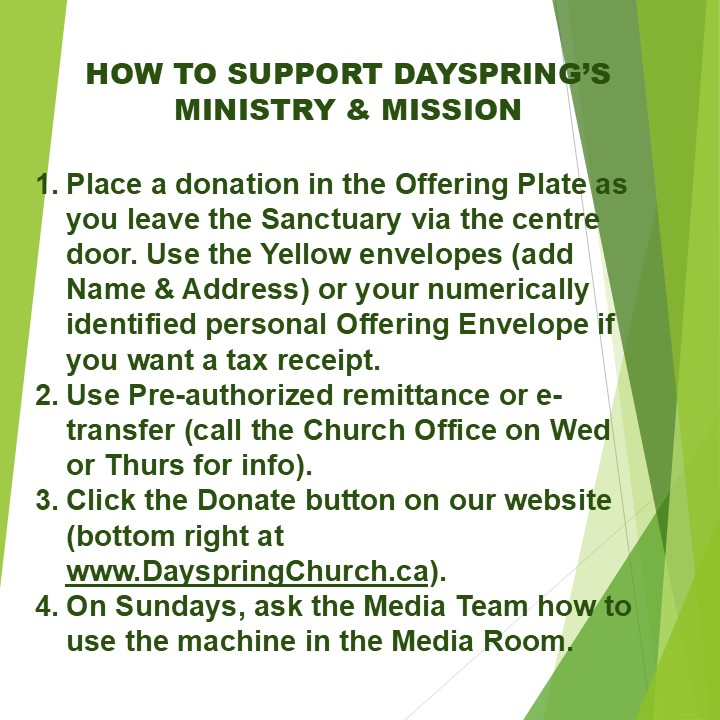
Prayer: Gift-giving God, we are so grateful for all that we enjoy in the world around us, and in the assurance that you love us all. Bless the gifts we offer today, that they may express your love for the world itself and to all who need to know you care, through Christ Jesus, your greatest gift.
Prayer of gratitude, and for others and ourselves
Gracious God,
sometimes we can simply breathe in the wonders of your creation
n a summer evening or in a quiet forest, and know your presence.
Other times, you surprise us in a word,
an unexpected kindness, a sense of your tenderness in prayer.
Whenever and however we meet you,
we are so grateful for your presence at the heart of our lives.
Assured of your great love for us, we bring before you the people we love
and the situations that cause us deep concern.
Today, we pray with those who rejoice at a baby’s birth or a summer wedding,
and with those who mourn the loss of a friend or loved one.
Silence for 5-10 seconds
We pray with those whose work has been rewarding and joy-giving,
and with those who are anxious because there is little or no work to be found.
Silence for 5-10 seconds
We pray with those who feel bored, without enough to do this summer,
and with those who are exhausted, facing still more to do and a never-ending list of tasks.
Silence for 5-10 seconds
We pray with those grateful for renewed good health,
and with those who find illness, anxiety or uncertain concerns lingering.
Silence for 5-10 seconds
We pray with those who have found peace or safety after turmoil,
and with those who fear what tomorrow might bring.
Silence for 5-10 seconds
We pray with those who enjoy the love of family and friends nearby,
and with those who feel lonely or isolated.
Silence for 5-10 seconds
Ever present God,
we thank you that you hear us in every situation of life,
for we all find ourselves in these situations sooner or later.
Help us to support each other, standing together in gladness and challenge.
Strengthen our life together as your people.
Give us the generosity we meet in Jesus
to respond wisely to those whose lives touch ours –
inside and outside your church.
May our hands serve as your hands in all that we do for Jesus’ sake.
We pray all this in your name. Amen.
Song: One more step along the world I go (641)
Sending out with God’s blessing
Go out into the world with patience, wisdom, and hope. Resist the urge to judge too quickly, remembering that God sees every heart and is always at work, even where we cannot yet see it.
Sow kindness, nurture what is good, and trust God with the harvest. May you grow in faith, bear good fruit, and share Christ’s love wherever you go.
Response: Sing Amen
Music postlude
————————————————————————-
Numbers in brackets after a song/hymn indicate that it is from the 1997 Book of Praise of the Presbyterian Church in Canada. Those and other songs are being used in accordance with the specifications of Dayspring’s licensing with One License (3095377) and CLC (A735555).
Lynn Vaughan retains the copyright (© 2026) on all original material in this service. As far as She is is aware, all of the material that has not been attributed to others is her own creation or is in the public domain. Unacknowledged use of copyrighted material is unintentional and will be corrected immediately upon notification being received.