
Worship on the Seventh Sunday after Pentecost
0:00 am July 12, 2026
Minister: Rev. Brad Childs Worship led by: Lynn Vaughan
Music Director: Binu Kapadia Vocalists: Sam and Ann May Malayang
Elder: Shirley Simpson Reader: Emma Pivato
Children’s time: Lynn Vaughan
We gather to worship God
Music prelude
Greeting
L: The grace of our Lord Jesus Christ be with you
P: and also with you
Lighting of the Christ candle
Welcome and announcements
Preparation for worship
Call to worship:
L: God’s Word is a lamp to our feet;
P: and a light to our path.
L: God’s Word is made visible in Christ;
P: in him, we are rooted in truth.
L: God’s Word is revealed through the Holy Spirit;
P: and lived out in faithful service.
L: Come and listen for God’s Word in this time of worship.
P: We wait to receive the Word of Life.
Opening praise: Come, now is the time to worship
Prayer of adoration and confession
God of wisdom,
You are the light of the minds that know you,
the strength of those who serve you,
and rest for those who seek you.
God of growth,
you sow and you gather,
you tend and you prune,
you judge and you save.
God who gives us life,
we come to you in worship,
to rest from our responsibilities,
to turn from our distractions,
and worship you as Creator, Christ and Spirit,
this day and always.
Loving God,
you have planted the seeds of faith in us,
but we confess we have too often not trusted you.
We fail to keep studying the wisdom of your word,
satisfied instead with what we think is true.
We consider that we already know enough,
rather than pursuing deeper encounters with you.
Forgive us, God, when we think you have nothing more to offer us.
Open our hearts to receive your truth with humility,
open our minds to wonder at your wisdom,
and open our lives to be shaped by your Spirit.
Prune away our pride, uproot our complacency,
and cultivate in us a hunger for your presence.
Renew us by your grace, so that we may grow in faith,
bear the fruit of love, and serve you with joy.
Thanks be to God. Amen.
Response: Glory, glory, hallelujah
Assurance of God’s pardon
The Apostle Paul reminds us that there is no condemnation for those who are in Christ Jesus. God’s Spirit sets us free from the powers of sin and death. Know that you are forgiven and forgive one another in Jesus’ name.
We listen for the voice of God
Song: Jesus we are gathered (514)
Children’s time: Seeds of Generosity
(Show kids a small packet of seeds) Look what I’ve got here. A great big garden full of delicious green beans. Yes sirree, that’s what I’ve got. // You don’t look convinced. (some kids may point out that you have only seeds, not plants)
Let’s find out exactly what we’ve got here. (pour seeds into hand) I need someone to help me count these seeds. // How many of these seeds do you think I should plant? One? Two? OR should I plant all of the seeds?
People who live in towns or cities might have flower beds or vegetable gardens. It doesn’t take too many seeds to grow those. People who live on farms and grow whole, big fields of crops need a lot more seeds. In Bible times, many people were farmers. Getting the land ready to plant was a big job.
What do you suppose would happen if they scattered just a few seeds like these over the entire farm field? Right – they’d only get a few plants. If they wanted a big harvest, they had to plant a lot of seeds. There’s a verse in the bible, 2 Corinthians 9:6, that says …
6 But remember this—if you give little, you will get little. A farmer who plants just a few seeds will get only a small crop, but if he plants much, he will reap much.
The Apostle Paul wrote this verse. He was writing to some people who weren’t sure they wanted to share what they had with others. He wanted them to know that if they were generous, it would be like planting a lot of seeds; they would get a big harvest. But if they were selfish, it would be like planting only a few seeds in a big field; they would get a small harvest.
God wants us to give generously – he wants us to plant lots of seeds! And he wants us to give cheerfully. God gives generously to us. Everything we have comes from God. He makes sure that we have what we need, so we can be generous with other people.
Let us pray: God, we thank you for everything that you give us. Make us grateful and glad to share in abundance. Help us see where we can plant seeds of generosity with other people, because you are generous with us. And now, together, we say the prayer that you taught us.
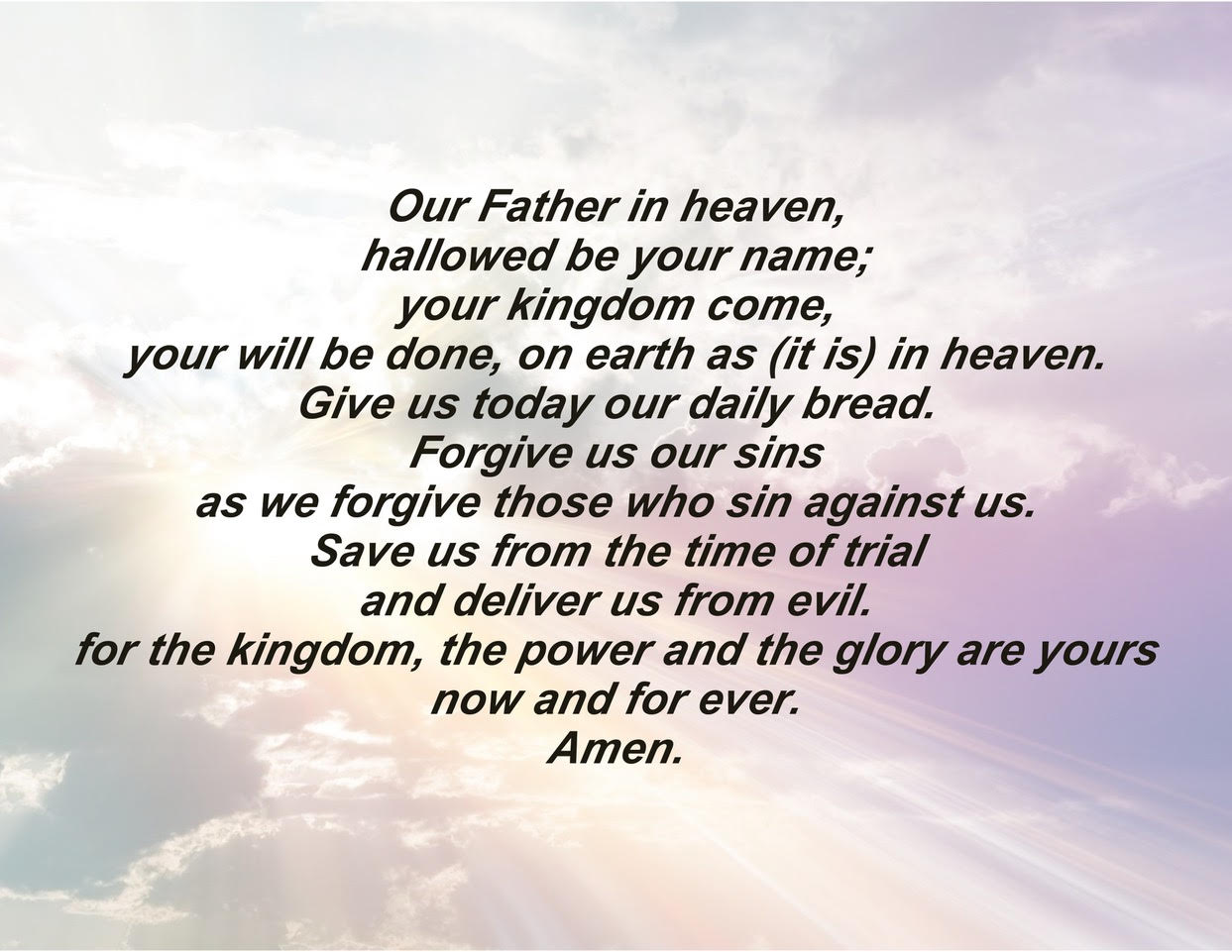
The Lord’s Prayer (535)
Song: Thy Word is a lamp unto my feet (496)
Scripture readings: Isaiah 55:10-13 and Matthew 13:1-9, 18-23
Response: Behold the lamb of God
Message: How does your garden grow?
The Parable of the Sower has always been near and dear to my heart. Many of you probably don’t know this, but I have a Bachelor of Science degree in agriculture. When I was growing up in the city, I always felt deep down in my heart that I was meant to be a farm girl. I worked on a couple different farms over the years – in Alberta and Manitoba, but also in New Zealand. After graduating from the University of Alberta, I worked for a few different government agencies, mainly sitting in offices and writing reports on agricultural trade statistics. So, I never really got much chance to get my hands dirty, so to speak, in the actual planting of the crops … and to this day, I can’t say that I have much of a green thumb when it comes to tending a garden. Even so, I really connect to this story with its agricultural theme, being such a farm girl at heart!
We’re told that the farmer is scattering seed widely and not worrying about where it would land. Some would land on rocky ground, some among the thorns, and some even on the walking path. But some of the seed does land on good soil, and the promise is that this seed will bring forth much grain. Jesus teaches us in this parable that when we sow the seed in this way, we don’t know where it will land. So, we are meant to just sow the seed of God’s word all over our corner of the world, and trust that some of it will find good soil.
Broadcasting
We can get so focused on results these days, on being efficient, that we can forget that this is a perfectly legitimate way to sow seed. I am no farmer, as I mentioned, but I have learned that this way of sowing seed is called “broadcasting.” It is a common way to sow seed, especially in days gone by. The farmer would walk the field with his bag of seed and scatter it all over, in a rainbow kind of pattern, casting it broadly. And the reason for doing this was simple: you farm on the field you’ve got. You plant on the land you have. Some of it might be rocky. Some of it might have some thorns. But, you farm on the field you’ve got. You prepare the ground that you have as best as you can, and you scatter the seed. And then? You take care of it … and let the good Lord do the rest.
This was the original use of the word, “broadcast” – to cast the seed broadly. It was not until the 1920s that the word began to have a new use. It was used to describe radio broadcasting, and eventually television broadcasting. In fact, NBC, CBS, ABC, and PBS all have the word “Broadcast” in their name. Just like radio, these networks sent out their signal to anyone who wanted to tune in. They scattered their programming widely. They “broadcast” it. And this created a whole new way of communicating and connecting our world together. Everyone could be listening or watching the same thing at the same time. It really was revolutionary, when you think about it.
It is kind of ironic to think of this now, as the Covid experience five years ago forced us to start “broadcasting” our worship services! It was a new way of doing church, that we could not have imagined previous to 2020. But it is one way to share the gospel to people potentially far away from here.
We are all searching for new ways to share our faith and our hope and our love these days. Social media. Texts and phone calls. Zoom calls. A lot has changed, but some things have not. We are still being called to scatter the seed, to broadcast the gospel, and we are continually having to find new ways to do so.
What Do We Want to Plant?
The truth is that we are scattering seed in our life all the time. Every day and in every way, we are scattering seed. The only question is, what kind of seed? What kind of seed are we scattering in this world? And, is it seed that will bring forth the harvest that we want to see?
What do we want to grow in this world? What do we want to see more of in the world? What would God like to see more of in the world? If we would like to see more kindness in the world, then shouldn’t we be sowing seeds of kindness? If we want to see more justice, then plant seeds of justice. More hope, then plant seeds of hope.
Throughout our day, every day, we all are planting seeds of one kind or another. Our words and our actions plant seeds. Everything that we do plants seeds. So, it is worth thinking about what kind of seeds we are planting with our lives. This applies to everyone: to pastors, teachers and students. To nurses and engineers. To those in sales and in business. To retirees. To all who follow Jesus.
In many different ways, through our daily lives, we are called to broadcast our seeds. To sow them widely. To take care of the field that we have been entrusted with. And then, to entrust the results of our labours to God. That is one of the things that this parable teaches us – to keep sowing the seed of God’s word, and don’t worry too much about where it lands. Just keep sowing. Keep loving. Keep giving. Keep praying. Keep serving. Keep sharing our faith. Keep hoping. Keep believing. And leave the results to God.
Good Soil
But there is one other point to this parable that I want to highlight today. Because this parable is not just addressed to those sowing the word. It is also addressed to those hearing the word. We know this is true because of the explanation of the parable that Jesus later gave to his disciples.
He shared with them that there are four different ways to hear this parable, or to hear God’s word. And only one of these ways is fruitful. Just because we are listening to God’s word, in other words, doesn’t mean that it will bear any fruit in our lives. So, it’s worth thinking about these four ways of hearing God’s word this morning. Because only one of these ways actually bears any fruit or makes any difference.
The first way of hearing the word, Jesus tells us, is what happens when the seed of God’s word lands on the walking path. It never really stands a chance. The evil one comes and snatches away what is sown in the heart, because the one hearing hasn’t taken the time or made the effort to understand God’s word. These are people who aren’t really listening. They have shut their minds to any other truth than their own. You’ve heard the saying, “I’ve made up my mind, so don’t confuse me with the facts”? Jesus tells us that there is no point in even approaching God’s word if we aren’t willing to be changed by it. An open mind and an open heart are both necessary for the seed to find good soil.
The second way to mis-hear God’s word, Jesus tells us, happens when the seed falls on shallow, rocky ground. It isn’t able to grow any roots, so that when the first storm of life comes, this person’s faith immediately blows away like a tumbleweed. Roots are important to the long-term health of a plant. Our faith roots cannot be seen by others, but they are essential to thrive. And making sure that our faith has deep roots, is essential to surviving life’s many storms with our faith and our hope intact.
The third way that God’s word does not find good soil happens when the seed lands among thorns. Jesus tells us that these thorns represent “the cares of the world and the lure of wealth.” And these cares and desires choke the word, so that it yields nothing. It is a challenge these days, more than ever I think, to make sure these types of thorns don’t take over our soil. There are so many cares and concerns in our world today – things like the idolization of material things, more pandemic scares, never-ending riots and uprisings, wars, and extreme weather issues, to name just a few. We need to stay vigilant, and rooted in God’s word, so that these cares and concerns, these thorns, don’t shout at us so loudly that we are no longer able to hear God’s voice in this world.
And finally, there is the good soil – those who truly hear God’s word, and who embrace it with open minds and open hearts, and who let it change their lives. And when we do that, God’s word planted in our hearts very naturally bears fruit, and yields even up to a hundredfold, as Jesus tells us. Good seed planted in good soil bears good fruit. Our task is to make sure that we are doing what we can to be that good soil. Opening our hearts, minds, and souls to God’s word. When we do, we will naturally bear good fruit.
Closing
And so, today, let us all pray that we would truly receive God’s word with an open heart. So that it can grow in our lives and yield new seeds, that we can then broadcast to the world. We are called to be the sower, who broadcasts the gospel through our words, our deeds, and our love, eagerly and generously, without any concern for where it lands. But to do that, we must first be the good soil, open to receiving the seed of God’s word.
May our hearts be open, our soil good, and our harvest plentiful. To the glory of God. Amen. (
Based on ‘Pastoral Ponderings’ by Rev. James Laurence, First Lutheran Church, Albemarle, NC)
Song: This is my Father’s world (328)
We respond to serve God
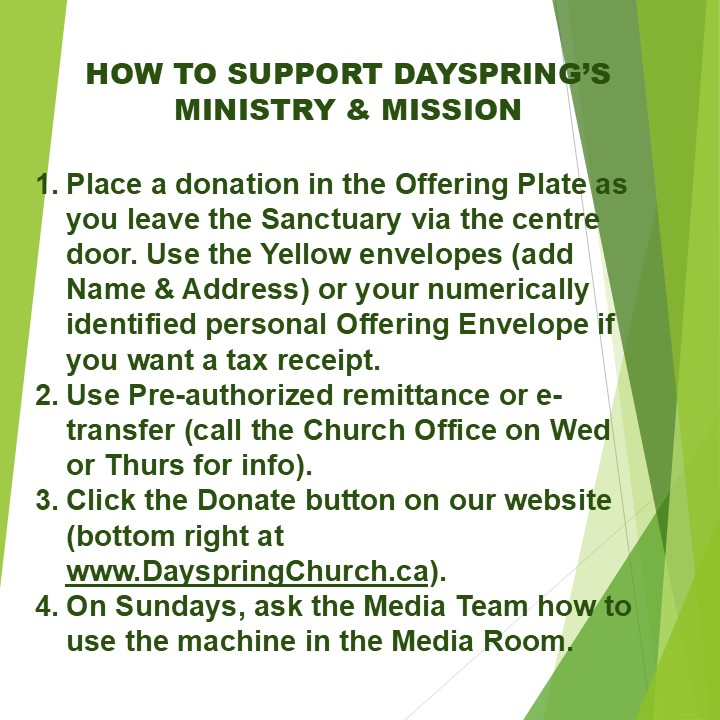
Our time of giving
God of growing seeds and souls, we offer our gifts in thanksgiving for your kindness to us. Bless and multiply them to add to the abundance of your love at work in the world. Make them seeds of new life to inspire faith in souls they touch in Jesus’ name.
Prayer of gratitude, and for others and ourselves
Tender and loving God,
you formed the earth to be a place of joy and abundance for all your creatures.
For food in all its variety and the people who grow it, transport it and prepare it,
we give you thanks.
We pray for those who cannot afford enough food,
and for those whose agricultural supply is at risk
through extreme weather, uncertain prices and social upheaval.
Help us care for the earth and its fruitfulness
and for each other in our common need of its fruits.
God, in your mercy, hear our prayer.
God of all the nations,
you gather people together in communities to care for each other
and enjoy each other’s company and creativity.
Thank you for the support we find in our congregation,
and for the difference volunteers make in our community.
Wherever there is division in the world, bring unity and peace with justice;
where people dispute opinions, give wisdom to see what is important;
where people are tired and anxious, bring strength and courage.
God, in your mercy, hear our prayer.
God of compassion,
you call us to be communities held together by prayer and love for our neighbours.
Thank you for the ministry that has blessed us
through the concern others have shown us.
Where people mourn loss of any kind, provide comfort;
where there is illness and pain, bring healing;
where there is distress or discouragement, transform fear into hope.
By your Spirit, equip us to serve one another in Christ’s name,
so that your compassion touches lives with love and mercy.
God, in your mercy, hear our prayer.
We offer you our prayers, spoken and unspoken, in the name of Jesus Christ,
our Lord and Saviour. Amen
Song: All things bright and beautiful (435)
Sending out with God’s blessing
Walk in the light of God’s Word as you leave our worship.
Look around at the seeds bearing fruit around you
and consider how you bear the fruit of God’s Word in your life.
May God the Spirit bring you growth;
May God the Son tend you with wisdom;
And may God the Source of all life bless you with all you need to thrive.
Response: Sing Amen
Music postlude
————————————————————————-
Numbers in brackets after a song/hymn indicate that it is from the 1997 Book of Praise of the Presbyterian Church in Canada. Those and other songs are being used in accordance with the specifications of Dayspring’s licensing with One License (3095377) and CLC (A735555).
Lynn Vaughan retains the copyright (© 2026) on all original material in this service. As far as She is is aware, all of the material that has not been attributed to others is her own creation or is in the public domain. Unacknowledged use of copyrighted material is unintentional and will be corrected immediately upon notification being received.